Feed aggregator

Market Premium For 10-Year Yield Holds Near Fair Value Estimate

The Capital Spectator -

The market premium for the US 10-year Treasury yield continues to trade near a fair value estimate, based on the average estimate of three models run by CapitalSpectator.com. Today’s update shows an ongoing extension of the near-neutral level for the benchmark rate in recent months, following several years of a high market premium.

The current estimate indicates that the 10-year yield traded roughly 22 basis points over fair value in December, based on analytics using monthly data. That’s close to the lowest market premium in three years.

The recent shift toward a neutral level continues to highlight the reversal of the previous sharp rise in the market premium during 2022-2024. The recent drop from the previous peak reminds that valuation for the 10-year yield remains cyclical, albeit on an irregular and difficult-to-forecast timing basis.

Despite the seemingly random fluctuations in the market premium/discount through time, history suggests that the cycle revolves around zero (neutral). In turn, this dynamic provides an implied forecast for managing exposure to maturity risk for a bond-market strategy.

The current reading, which reflects a slight premium, implies a recommendation to adopt a more or less neutral stance for maturity risk vis-à-vis the 10-year yield.

By contrast, a higher allocation to maturity risk looked timely in late-2023, when the market premium was relatively high – above 120 basis points at the peak. Since then, the 10-year yield has fallen and the bond market has rallied.

There’s no guarantee that the cycle will continue to repeat, although it does appear to rhyme. Betting otherwise still looks like an excessively risky assumption.


Micro-caps Lead The Stock Market So Far In 2026–Can It Last?

The Capital Spectator -

It’s still too early to draw conclusions about how or if the new year will differ from 2025 from a US equity market perspective. But a possible early clue that a shift is underway can be gleaned from reviewing performances for US equity factors so far in 2026.

We’re still less than two trading weeks into the year and so a boatload of caveats accompanies any data dive at this point. But after looking at the numbers it’s hard not to wonder if the trading year ahead will remix the narrative of winners, losers and relative laggards. Let’s start by stacking up performances of the main factor risks for stocks via a set of ETFs. (In a separte post, I’ll follow up with the same treatment for equity sectors.)

The factor leader for US equities so far in 2026: micro-cap shares (IWC), which is posting a 6.2% rise through yesterday’s close (Jan. 12). For the moment, the performance flips the script on last year, when the high-beta factor (SPHB) outperformed the field by a wide margin. So far this year, high beta (SPHB) is trailing, albeit only modestly via a 5.1% year-to-date gain.

US stocks overall, via the SPDR S&P 500 ETF (SPY), are even further behind, rising a relatively modest 1.9% year to date (red line in chart above).

The weakest factor performance so far in 2026: the low-volatility factor (USMV), which is struggling to keep up and is currently higher by just 0.7% this year.

Drawing conclusions from 2026’s six trading days may be little better than a coin flip at this point, but it’s worth noting the IWC’s leadership is hardly a bolt from the blue. The fund has been on a roll for months, and its current technical profile still looks bullish. Indeed, the fund closed at a new high yesterday, which suggests the party will continue for the foreseeable future.

Micro-caps tend to fly under the radar on Wall Street, a bias that’s been easy to rationalize in recent years amid large-cap dominance. But if the early results of 2026 are a guide, it’s timely to keep an eye on the smallest tier of publicly traded companies.  


Will Markets React To The US Investigation Of Fed’s Powell?

The Capital Spectator -

Another week, and another new risk factor to digest. This time it’s a sharp escalation in President Donald Trump’s struggle with the Federal Reserve, which critics charge is a thinly-veiled effort to force the central bank to lower interest rates.

On Sunday evening, Federal Reserve Chair Jerome Powell said in a statement that the Department of Justice is investigating him in a criminal probe related to the $2.5 billion renovation to the central bank’s headquarters in Washington, DC.

Asked about the investigation of Powell, Trump told NBC News: “I don’t know anything about it.”

The question, once again: Will markets react? Or, will recent history repeat, in which case the crowd will look through the news and keep the bull market humming?

Meantime, Fed Chair Jerome Powell has come out swinging. In a two-minute video statement released Sunday evening, he framed the investigation as a new tactic by President Trump in reaction to the Fed’s refusal to cut interest rates quickly, to a level that the president demands.

“The threat of criminal charges is a consequence of the Federal Reserve setting interest rates based on our best assessment of what will serve the public, rather than following the preferences of the President,” Powell said in his statement. “This is about whether the Fed will be able to continue to set interest rates based on evidence and economic conditions — or whether instead monetary policy will be directed by political pressure or intimidation.”

Trading this week will be closely watched and viewed through the lens of the Fed investigation. For some analysts, the news casts a pall over the near-term outlook for the risk appetite.

“We expect the dollar, bonds and stocks to all fall in Monday trading in a sell-America trade similar to that in April last year at the peak of the tariff shock and earlier threat to Powell’s position as Fed chair, with global investors applying a higher risk premium to US assets,” Krishna Guha, an analyst at Evercore ISI, wrote to clients in a note.

Blake Gwinn, head of US rates strategy at RBC Capital Markets, said: “Markets will start to price in greater inflation expectations, inflation risk premium, and term premium if the Fed’s independence comes under further attack. We don’t appear to have hit it yet, but every action is another step closer to it.”

The crucial variable is how Treasury yields react, or don’t. As I noted in this week’s edition of The ETF Portfolio Strategist, “Yields are still trading in a relatively low range. When/if that changes, markets writ large could reassess the risk appetite, but such an attitude adjustment doesn’t look near.”

That was written before Powell’s statement was released. Has the yield calculus changed in the last several hours? We’re about to find out.  

At Friday’s close, the US 10-year Treasury yield was still trading in a tight range that’s prevailed since September. Traders will be watching to see if it breaks higher this week and breaches the 4.20% mark that’s been a ceiling in recent months.  

Keep an eye on the 30-year yield, too, the most inflation-sensitive rate.  Will the moderate upturn in this yield since October continue this week?

If the playbook of 2025 holds, markets will suffer a run of tubulence and then recover. It’s any one’s guess if that script gets a reboot in this year’s sequel. But to the extent that markets will drop clues about where we’re heading, the directional bias of Treasury yields, or the lack thereof, is on my short list as critical factors for setting (or re-setting) the mood on Wall Street.

Is Recession Risk Rising? Monitor the outlook with a subscription to:
The US Business Cycle Risk Report

Book Bits: 10 January 2026

The Capital Spectator -

Blood and Treasure: The Economics of Conflict from the Vikings to the Modern Era
Duncan Weldon
Review via The Economist
Of all human activities, war is the least rational. It costs a fortune. It spreads death and misery, from the killing fields of Sudan to the tunnels of Gaza. It is often started out of personal hubris or blind patriotic zeal: think of Napoleon’s invasion of Russia or Japan’s decision in 1941 to provoke a war with a superpower it could not hope to defeat. So you might think economics—a discipline associated with rational self-interest—would have little to say about it. You would be wrong, argues Duncan Weldon, a former writer for and occasional contributor to The Economist, in “Blood and Treasure”.

Ruthless: A New History of Britain’s Rise to Wealth and Power, 1660-1800
Edmond Smith
Summary via publisher (Yale U. Press)
Was Britain’s industrial revolution the result of its machines, which produced goods with miraculous efficiency? Was it the country’s natural abundance, which provided coal for its engines, ores for its furnaces and food for its labourers? Or was it Britain’s colonies, where a brutalized enslaved workforce produced cotton for its factories? Acclaimed historian Edmond Smith shows how the world’s first industrial nation was founded on the ruthless exploitation of technology, people and the planet. This economic system linked the plantations of the Caribbean with the colossal cotton mills of northern England, applied the innovations of science and agriculture to colonial exploration, and formalised financial markets in self-serving ways. At the heart of these processes were Britons themselves, early capitalists who spun webs of expertise and investment to connect exploitative practices across the globe.

The Permanent Problem: The Uncertain Transition from Mass Plenty to Mass Flourishing
Brink Lindsey
Review via The Unpopulist
As in the 1970s, some of the sharpest criticism—and certainly the most intelligent—comes from inside the house: distinguished liberal thinkers like Francis Fukuyama, William Galston, and James Davison Hunter. Arriving to join them is Brink Lindsey of the Niskanen Center, a Washington think-tank. Once a scholar at the libertarian Cato Institute, Lindsey remains within the liberal camp but has strayed from neoliberal orthodoxy. Just how far is apparent in his new book, The Permanent Problem: The Uncertain Transition from Mass Plenty to Mass Flourishing.
Lindsey begins with a famous challenge framed by the economist John Maynard Keynes in his 1930 essay “Economic Possibilities for Our Grandchildren.” “For the first time since his creation,” Keynes wrote, “man will be faced with his real, his permanent problem—how to use his freedom from pressing economic cares, how to occupy the leisure which science and compound interest will have won for him, to live wisely and agreeably and well.”

If Russia Wins: A Scenario
Carlo Masala
Review via Financial Times
Masala portrays European leaders as naive, short-sighted and divided. Only the German chancellor stands out — but in isolation. France is under far-right rule and has turned its back on Berlin. The UK prime minister is a good guy, though makes rare, largely inconsequential appearances — an unfair characterisation, perhaps, given current realities.
The result is a well-informed — albeit a tad German-centric — script on how autocracies could prevail, that could inspire a film in the mould of Dr Strangelove, though without the humour of Stanley Kubrick’s 1964 dark comedy about the world’s descent into nuclear annihilation.

Please note that the links to books above are affiliate links with Amazon.com and James Picerno (a.k.a. The Capital Spectator) earns money if you buy one of the titles listed. Also note that you will not pay extra for a book even though it generates revenue for The Capital Spectator. By purchasing books through this site, you provide support for The Capital Spectator’s free content. Thank you!

Research Review | 9 January 2026 | Tariffs and Trade Wars

The Capital Spectator -

Tariff Pass-through into Retail Prices: Measurement, Replacement, and Shrink-flation
Liang Bai (King’s College London), et al.
December 2025
To what extent do import tariffs pass-through into retail prices? Existing estimates for the U.S.-China trade war present a puzzle: pass-through into U.S. border prices was complete with seemingly no effect on retail prices. We combine barcode country-of-origin data with retail scanner data to address this apparent discrepancy in the context of consumer goods. Within barcodes, tariff pass-through into retail prices is 14%, yet pass-through into aggregated price per unit weight is 44%. This discrepancy is attributable to product replacement bias: pass-through occurs predominantly via product turn-over towards barcodes with smaller package size, even within narrow firm-product combinations. Confidence intervals overlap considerably with existing estimates of the foreign cost share of U.S. retail imports, which we validate, such that we cannot reject full tariff pass-through into retail prices.

What Can History Tell Us About Tariff Shocks?
Regis Barnichon and Aayush Singh (San Francisco Fed)
January 2026
The change in the average U.S. tariff rate in 2025 was the largest in the modern era. One way to assess the effects of such a large shock on unemployment and inflation is by looking at data from pre-World War II periods with tariff rate changes of a similar magnitude. Analysis shows that previous tariff hikes raised unemployment and reduced both economic activity and inflation. Uncertainty may be a factor behind these effects: A large tariff increase raises uncertainty, which can depress overall demand and lead to lower inflation.

Trade, Tariffs, and Treasuries: The Hidden Cost of Trump’s Protectionism
Rebecca Patterson and Ishaan Thakker (Council on Foreign Relations)
December 2025
The Trump administration’s trade policy—specifically its broad, aggressive use of tariffs—has several direct economic costs and benefits: higher inflation, an effective tax on consumers and businesses, and increased government revenue. Trade policy also has a number of indirect implications, including on the U.S. Treasury market. Treasuries are critically important for the United States, from economic, financial market, and geostrategic lenses, and policymakers need to understand their potential impacts in the next year and beyond. Three avenues are particularly noteworthy: bond supply, bond demand, and the effect of economic growth and inflation trends on the Treasury yield curve. Several trade-related policy ideas could help ensure that the Treasury market remains sound over the longer term.

What is the evidence on the effectiveness of fiscal spending in response to terms-of-trade shocks?
Carlos J. Garcia and Wildo Gonzalez (Alberto Hurtado University)
December 2025
This study uses local projections with nonlinear interactions to estimate the impact of spending on economies suffering from shock terms of trade. Such a shock could be precipitated by several factors, including an escalation in tariffs. The extant evidence suggests that this policy can counteract such shocks, especially in conjunction with free capital flows and a flexible exchange rate. The result contradicts existing literature and would change policy recommendations.

Higher Tariffs Might Have Created Headwinds to Employment Growth in 2025
Johannes Matschke and Mariia Dzholos (Kansas City Fed)
December 2025
Job growth in the United States has slowed considerably this year. We examine the effect of tariffs on job growth and argue that sectors with higher exposure to imports had greater reductions in hiring. Tariffs therefore could have reduced job growth, though there is considerable uncertainty about the effect.

Tariffs and Technological Hegemony
Luca Fornaro (CREi) and Martin Wolf (U. Of St Gallen)
December 2025
The Trump administration’s sweeping tariff measures are intended to increase the competitiveness of US firms – especially in high-tech sectors – and reduce US trade deficits. This column discusses the impact of trade policies on innovation and technological hegemony. The analysis suggests that large and persistent changes in tariffs are likely to affect firms’ innovation decisions and the pattern of technological hegemony. However, countries should be wary of using trade policies to boost innovation by their domestic high-tech firms, since the strategy may easily backfire.

The Incidence of Tariffs: Rates and Reality
Gita Gopinath (Harvard U./NBER) and Brent Neiman (U. of Chicago/NBER)
January 2026
In 2025, statutory tariff rates on U.S. imports rose to levels not seen in over one hundred years. What are the implications for prices? On the one hand, shipping lags, exemptions, and enforcement gaps have kept the actual implemented rates at only half of the statutory rates, moderating the tariffs’ impact. On the other hand, tariff pass-through to U.S. import prices is almost 100 percent, so the United States is bearing a large share of the costs. We study the incidence of the 2018-2019 and 2025 U.S. tariffs and discuss implications for U.S. sourcing, domestic manufacturing costs, and the dollar.

Is Recession Risk Rising? Monitor the outlook with a subscription to:
The US Business Cycle Risk Report

The Holiday Impact on Ethereum and What to Expect Going Into the New Year

Money Under 30 -

The holiday season is often full of reflection and taking stock of values, both internally and externally. For many people, the holidays mean a time of introspection and a twinge of existentialism, but they also signal a time of new professional beginnings. This is why it’s become critical to keep a keen eye on the […]

Will The Supreme Court Rule Against Trump’s Tariffs?

The Capital Spectator -

The answer is pending as early as tomorrow (Friday, Jan. 9), when the High Court is expected to issue rulings, which could include a decision on the legality of President Trump’s global tariffs. Hanging in the balance: the potential for billions of dollars in tariff refunds, along with a major setback for Trump’s use of presidential authority over trade policy. Add in a hefty dose of confusion about the implications for markets and the economy and it’s clear that Supreme Court’s decision on tariffs could be a significant event that reverberates through the months and years ahead.

Betting markets are pricing in low odds the court will rule in Trump’s favor. At the betting site Kalshi, the crowd is pricing in 28% chance that the President will win and continue to wield near total control over US tariff policy by invoking the International Emergency Economic Powers Act on imported goods. Polymarket’s current estimate is lower, trading at 24% this morning.

A court smackdown on Trump’s tariffs would be a blow to the administration’s economic playbook and mark the biggest setback for the President’s agenda. A warning shot for the White House arose on November 5, when several Court justices raised doubts about the legal integrity of Trump’s use of emergency power to impose tariffs. As Politico reported at the time:

Chief Justice John Roberts questioned why Trump believed he had the authority to impose tariffs under a nearly 50-year-old law, the International Emergency Economic Powers Act, that has never been used for that purpose.

Tariffs are a form of taxation and “that has always been the core power of Congress,” Roberts said. “So, to have the president’s foreign affairs power trump that basic power for Congress seems to me to kind of neutralize between the two powers, the executive power and the legislative power.”

The President recognizes the high stakes for his economic agenda, writing in a social media post on Friday that a ruling against his tariff policy would be a “terrible blow” to the US.

According to a Reuters report, over $133.5 billion in tariffs might have to be handed back. In that case, a tsunami of questions would emerge about when the money is refunded, how it’s paid, and what replaces those policies? There’s also the issue of how tariff refunds affect the federal budget deficit.

Perhaps the biggest uncertainty is the effect on the economy.

“If the tariffs are here to stay, then I would expect this leads to more price increases to come by those who have, for now, held back and not changed prices yet because they’re unsure about the permanence of these tariffs,” Felix Tintelnot, a professor of economics at Duke University, told ABC News in November.

Alternatively, “If we remove these tariffs, it would reduce the inflationary pressure and that might give the Fed more room to cut interest rates than if we kept these tariffs for longer,” Tintelnot said.

Learn To Use R For Portfolio Analysis
Quantitative Investment Portfolio Analytics In R:
An Introduction To R For Modeling Portfolio Risk and Return

By James Picerno

Markets Barely Blink After US Removes Venezuela’s Maduro

The Capital Spectator -

The news was certainly dramatic. But financial and commodity markets have shrugged following the news that the US, in a daring raid on Saturday, captured Nicolás Maduro, Venezuela’s president, and brought him to New York to stand trial on drugs and weapons charges.

These are still early days and so the jury’s still out on the macro and geopolitical repercussions in the wake of what some are calling a revival of gunboat diplomacy. As a number of analysts advise, there are several possibilities that may radiate from the US attack on Venezuela, including an eventual regime change in Caracas, emboldening Russia and China to take similar actions in their respective hemispheres, and the collapse of Cuba’s communist government, which has relied on Venezuela’s financial support, to name but a few of the scenarios considered.  

For the oil market, the potential for reviving Venezuela’s ailing energy industry suggests a significant ramp up in the country’s output of heavy crude. The stakes, at least on paper, are huge: Analysts estimate that the country has the world’s largest proven reserves.

In the near term, however, it’s unlikely Venezuela’s oil output will rise significantly, according to oil industry executives. Chevron, the only US oil firm still operating in Venezuela, is positioned to be an early beneficiary if the country’s political climate turns favorable for renovating its oil infrastructure, which produces a small fraction of potential output due to mismanagement and corruption.

From the perspective of oil firms in the West, however, an early rush back into Venezuela is unlikely. “The appetite for jumping into Venezuela right now is pretty low. We have no idea what the government there will look like,” an oil-industry source told CNN on Monday.

Meantime, the early reaction in financial and commodity markets to Maduro’s toppling remains muted. Let’s start with the oil market. The price of crude was trending lower before Saturday’s raid, and in the first two trading days following the attack the price slide still looks intact. The US benchmark (West Texas Intermediate) closed just below $57 a barrel on Tuesday (Jan. 6), close to a five-year low.

Crude oil’s technical profile was already bearish before the US raid. To the extent that oil output in Venezuela rises, the news will likely exacerbate downside risk for oil prices.

The potential for opening up vast reserves to Big Oil excited investors on Monday. But the surge in the price of a basket of major oil firms, via the SPDR Energy Select ETF (XLE), reversed on Tuesday, leaving the fund in what still looks like a trading range vs. the last several months.

The US stock market appears unaffected by the Venezuela news, which is to say that equities continue to rally: the SPDR S&P 500 ETF (SPY) closed at a new high on Tuesday.

Turning to the bond market, there’s been no obvious impact on Treasury yields. The benchmark 10-year yield, for example, continued to trade at a middling level vs. recent history, ending Tuesday’s trading session at 4.17%.

For now, markets have yawned at the Venezuela news. Although there are significant geopolitical implications linked to the event for the months and years ahead, investors so far are inclined to look through the removal of Maduro as a minor news story with little, if any, effect on expected risk and return.


US Economy Expected To Cool In Q4, Based On Latest Nowcasts

The Capital Spectator -

After two straight quarters of strong growth, US economic output is on track to downshift in the upcoming report on 2025’s fourth quarter, according to the median estimate for a set of GDP nowcasts compiled by CapitalSpectator.com. The expected growth downgrade is substantial, but is unlikely to trigger a recession warning, based on the current numbers.

Q4 GDP is projected to rise by a modest 1.3% (annualized changed), according to today’s median estimate. That’s sharply below the sizzling 4.3% increase reported for Q3. The Bureau of Economic Analysis was originally scheduled to publish Q4 data on Jan. 29, but the government shutdown has delayed the update to a yet-to-be announced date.

The most optimistic component of the median estimate is the Atlanta Fed’s GDPnow model, which is currently estimating a 2.7% rise in GDP (as of Jan. 5). But even assuming this estimate is accurate, it still equates with a significant slowdown in growth following the strong run during Q2 and Q3.

Looking beyond Q4 still presents an upbeat outlook, says Michael Pearce, chief US economist at Oxford Economics. “We expect fading policy uncertainty, the boost from tax cuts and the recent loosening of monetary policy to mean the economy strengthens in 2026,”

Perhaps, but the latest nowcasts suggests some degree of cooling in the final quarter of 2025 before a possible revival this year. “The flash PMI data for December suggest that the recent economic growth spurt is losing momentum,” said Chris Williamson, Chief Business Economist at S&P Global Market Intelligence, referring to his firm’s survey-based GDP proxy indicator. Speaking in mid-December, he advised: “With new sales growth waning especially sharply in the lead up to the holiday season, economic activity may soften further as we head into 2026.”

Is Recession Risk Rising? Monitor the outlook with a subscription to:
The US Business Cycle Risk Report

Total Return Forecasts: Major Asset Classes | 5 January 2026

The Capital Spectator -

Long-term expectations for the Global Market Index (GMI) remained steady at a 7%-plus pace for the annualized total return outlook, based on data analytics through December. The forecast has been relatively stable at this level recently, rising fractionally over last month’s estimate.

GMI is a market-value weighted mix of the major asset classes (excluding cash) via ETF proxies. Today’s forecast is based on the average of three models (defined below). The current 7.3% annualized estimate is slightly above the December estimate, but remains well below the trailing 9.4% annualized return that GMI has generated over the past ten years.

The majority of GMI’s components are projected to perform at a pace that’s above their respective trailing 10-year results. But in a possible sign that GMI’s return outlook will downshift in the months ahead, there’s been a rise in the number of asset classes posting expected returns that are below their trailing 10-year realized performances. At the extreme: US stocks, which are projected to earn an annualized 8.7% total return in the long-run future, which is 5.5 percentage points below the 14.2% annualized gain over the past decade.

GMI represents a theoretical benchmark for the “optimal” portfolio that’s suited for the average investor with an infinite time horizon. Accordingly, GMI is useful as a starting point for customizing asset allocation and portfolio design to match a particular investor’s expectations, objectives, risk tolerance, etc. GMI’s history suggests that this passive benchmark’s performance will be competitive with most active asset-allocation strategies, especially after adjusting for risk, trading costs and taxes.

It’s likely that some, most or possibly all of the forecasts above will be wide of the mark in some degree. GMI’s projections, however, are expected to be somewhat more reliable vs. the estimates for its  components. Predictions for the specific markets (US stocks, commodities, etc.) are subject to greater volatility and tracking error compared with aggregating the forecasts into the GMI estimate, a process that may reduce some of the errors through time.

Another way to view the projections above is to use the estimates as a baseline for refining expectations. For instance, the point forecasts can be adjusted with additional modeling that accounts for other factors not used here. Customizing portfolios for a specfic investor, to reflect risk tolerance, time horizon, and so on, is also recommended.

For perspective on how GMI’s realized total return has evolved through time, consider the benchmark’s track record on a rolling 10-year annualized basis. The chart below compares GMI’s performance vs. ETFs tracking US stocks and US bonds through last month. GMI’s current return for the past ten years is 9.4%, a robust performance that’s in line with recent history.

Here’s a brief summary of how the forecasts are generated and definitions of the other metrics in the table above:

BB: The Building Block model uses historical returns as a proxy for estimating the future. The sample period used starts in January 1998 (the earliest available date for all the asset classes listed above). The procedure is to calculate the risk premium for each asset class, compute the annualized return and then add an expected risk-free rate to generate a total return forecast. For the expected risk-free rate, we’re using the latest yield on the 10-year Treasury Inflation Protected Security (TIPS). This yield is considered a market estimate of a risk-free, real (inflation-adjusted) return for a “safe” asset — this “risk-free” rate is also used for all the models outlined below. Note that the BB model used here is (loosely) based on a methodology originally outlined by Ibbotson Associates (a division of Morningstar).

EQ: The Equilibrium model reverse engineers expected return by way of risk. Rather than trying to predict return directly, this model relies on the somewhat more reliable framework of using risk metrics to estimate future performance. The process is relatively robust in the sense that forecasting risk is slightly easier than projecting return. The three inputs:

* An estimate of the overall portfolio’s expected market price of risk, defined as the Sharpe ratio, which is the ratio of risk premia to volatility (standard deviation). Note: the “portfolio” here and throughout is defined as GMI

* The expected volatility (standard deviation) of each asset (GMI’s market components)

* The expected correlation for each asset relative to the portfolio (GMI)

This model for estimating equilibrium returns was initially outlined in a 1974 paper by Professor Bill Sharpe. For a summary, see Gary Brinson’s explanation in Chapter 3 of The Portable MBA in Investment. I also review the model in my book Dynamic Asset Allocation. Note that this methodology initially estimates a risk premium and then adds an expected risk-free rate to arrive at total return forecasts. The expected risk-free rate is outlined in BB above.

ADJ: This methodology is identical to the Equilibrium model (EQ) outlined above with one exception: the forecasts are adjusted based on short-term momentum and longer-term mean reversion factors. Momentum is defined as the current price relative to the trailing 12-month moving average. The mean reversion factor is estimated as the current price relative to the trailing 60-month (5-year) moving average. The equilibrium forecasts are adjusted based on current prices relative to the 12-month and 60-month moving averages. If current prices are above (below) the moving averages, the unadjusted risk premia estimates are decreased (increased). The formula for adjustment is simply taking the inverse of the average of the current price to the two moving averages. For example: if an asset class’s current price is 10% above its 12-month moving average and 20% over its 60-month moving average, the unadjusted forecast is reduced by 15% (the average of 10% and 20%). The logic here is that when prices are relatively high vs. recent history, the equilibrium forecasts are reduced. On the flip side, when prices are relatively low vs. recent history, the equilibrium forecasts are increased.

Avg: This column is a simple average of the three forecasts for each row (asset class)

10yr Ret: For perspective on actual returns, this column shows the trailing 10-year annualized total return for the asset classes through the current target month.

Spread: Average-model forecast less trailing 10-year return.



Book Bits: 4 January 2026

The Capital Spectator -

The Web Beneath the Waves: The Fragile Cables that Connect our World
Samanth Subramanian
Review via Los Angeles Review of Books
Nearly twenty years ago, during a congressional debate over net neutrality, Senator Ted Stevens of Alaska described the internet as a “series of tubes.” The remark became an instant meme, a rhetorical relic that suggested an antediluvian age when telecommunications depended on switchboard operators, wires, and cables.
In retrospect, Stevens’s statement was far from absurd. For, as Samanth Subramanian’s excellent new book The Web Beneath the Waves: The Fragile Cables That Connect Our World makes clear, the internet does indeed consist (at least in part) of a vast network of glass tubes—fiber-optic cables. We think of the internet as an abstraction, a view reflected in the lexicon of the data economy—the cloud, AirDrop, even the Ethernet cable. But, though cyberspace may be virtual, it relies on earthly infrastructure. The apparent weightlessness of the internet depends on very physical cables, the most important of which run deep under the world’s oceans. Ninety-nine percent of the world’s data zips through these filaments, which are only three inches wide. These threads on the seafloor are the world’s information superhighways. They are also tremendously fragile, exposed to natural disaster, marine accident, and sabotage. Indeed, the most vulnerable part of the global data infrastructure may well be the part that has been submerged.

The Future After AI: Expectations for Artificial Intelligence as the New Operating System of Finance, Technology, Energy, Healthcare, Education, and Business
Jason Schenker
Press release for book
In The Future After AI, Jason Schenker explains how AI is shifting from a surprising new technology to the quiet bedrock powering finance, energy, technology, healthcare, education, business, cities, and national security. Schenker explores how AI is transforming the global economy in ways as profound as the internet and computers once did. But just as we no longer marvel at using the internet, AI’s impact is likely to become so deeply embedded in technology and society that we might soon stop talking about it at all. Through data-driven analysis, forward-looking scenarios, and insights drawn from his work advising global companies, investment firms, and governments, Schenker reveals how AI will redefine productivity, reshape power structures, and become an invisible core part of the way the world works. The future will be AI-enabled, AI-integrated, and AI-invisible.

Capital Evolution: The New American Economy
Seth Levine and Elizabeth MacBride
Summary via publisher (Simon & Schuster)
In Capital Evolution: The New American Economy, Seth Levine and Elizabeth MacBride deliver a bold and timely reassessment of capitalism in America. Drawing on decades of experience in finance, journalism, and policy, Levine and MacBride argue that capitalism isn’t the problem—it’s the outdated neoliberal version we’ve been practicing that’s failing us. From the rise of populism to the growing disillusionment among younger generations, the signs of strain are everywhere. But Levine and MacBride reveal how a new consensus—what they call Dynamic Capitalism—is already taking shape, one that balances profit with purpose, empowers the middle class, and addresses the urgent challenges of inequality and climate change.

Please note that the links to books above are affiliate links with Amazon.com and James Picerno (a.k.a. The Capital Spectator) earns money if you buy one of the titles listed. Also note that you will not pay extra for a book even though it generates revenue for The Capital Spectator. By purchasing books through this site, you provide support for The Capital Spectator’s free content. Thank you!

Major Asset Classes | December 2025 | Performance Review

The Capital Spectator -

Global markets endured a volatile run in 2025, but when the last trades closed on Dec. 31 all the major asset classes posted gains for the year, based on a set of ETFs. As a result, outperforming passive global asset allocation strategies was unusually difficult in 2025… again. All the more so for portfolios that were heavily weighted in US assets and downplayed international diversification.

The leading performer: stocks in developed markets ex-US. Vanguard FTSE Developed Markets ETF (VEA) surged 35%, more than double the gain for US shares (VTI).

Stocks in emerging markets (VWO) posted a strong second-place performance, rising nearly 26%, just ahead of foreign real estate (VNQI), which rallied more than 21% in 2025.

The weakest performer for the major asset classes: US real estate investment trusts (VNQ), with a meek 3.3% advance last year — a gain that trailed the 4.2% increase for cash (SHV) in 2025.

Gold (GLD) was a standout winner last year among alternative assets, soaring nearly 64%, while bitcoin (GBTC) slumped in 2025.

The Global Market Index (GMI) enjoyed another strong calendar-year run in 2025, posting its third straight double-digit gain by rising nearly 19%. GMI is an unmanaged benchmark (maintained by CapitalSpectator.com) that holds all the major asset classes (except cash) in market-value weights via ETFs and represents a competitive benchmark for multi-asset-class portfolios.


Will The Bond Market Help Keep Stocks Humming In 2026?

The Capital Spectator -

Identifying the reasons why the stock market rises or falls is challenging, if not impossible, but the slide in interest rates has surely bees a non-trivial factor in lifting equities this year. A key question for 2026: Will the tailwind continue?

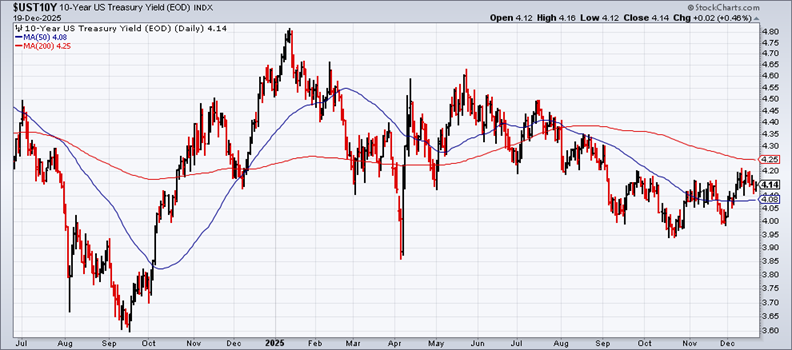
Consider the 10-year Treasury yield, perhaps the world’s most important rate, given its influence over a wide range of lending activity. Although it’s the 10-year yield has had a volatile ride at times in 2025, looking back over the year reminds that the general trend has been down.

Despite various threats, from tariff-related inflation to concerns related to the rise of the US government’s budget deficit, the 10-year yield looks set to end 2025 well below where it started the year: 4.14% on Friday, Dec. 19, down from a peak of roughly 4.80% at one point in January. Expectations for a softer economy are helping drive the trend.

Dovish Fed policy has also helped. Although the central has limited, at times nil, influence over the long end of the yield curve, three interest rate cuts this year have provided support for keeping the bond market happy, or at least reluctant to revolt.

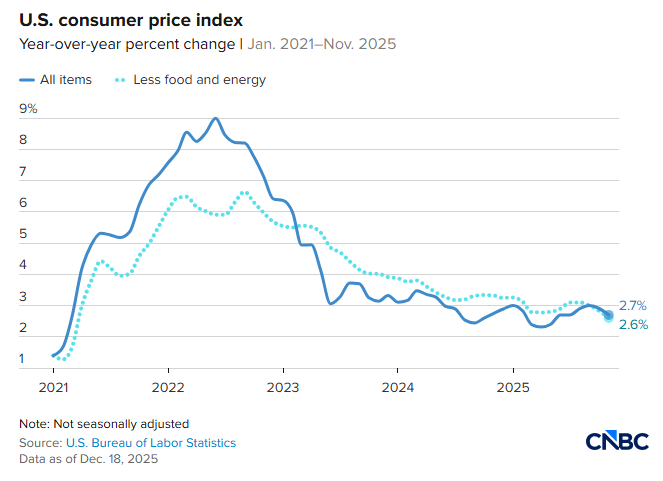
Another bullish factor for bonds is the lack of a clear effect on inflation following the rise in tariffs. Although many economists expected a sharp increase in pricing pressure, official statistics have yet to show a clear connection. The delayed release of the November consumer price data last week highlights the lack of follow-through for inflation following higher tariffs. The government reports that inflation has been relatively steady in the 2.5%-3.0% range in 2025. Although that’s still above the Fed’s 2% target, the official numbers indicate that inflation has remained comparatively steady this year.

Skeptics argue that the November CPI data looks a bit too good to be true. “It’s hard to read too much into the November inflation data. The shutdown clearly had a big impact on data collection,” Heather Long, chief economist at Navy Federal Credit Union, advised in a note to clients.

Reliable or not, the bond market appears to accept the view that inflation is holding in a 2.5%-3.0% range. Even the 30-year Treasury yield – the most inflation-sensitive maturity on the curve – has been relatively calm lately. Although it’s up about 30 basis points over the past two months, it continues to trade in a middling range this year, closing on Friday at 4.82%.

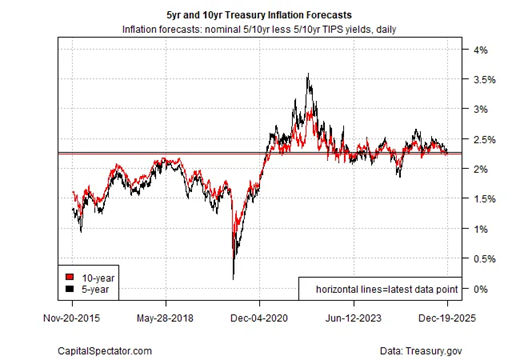
The Treasury market’s implied inflation forecasts are also steady, trading modestly above the Fed’s 2% target. According to this corner of the bond market, investors appear unconcerned about inflation risk in the near term.

Consumer inflation expectations are still running well above the Fed’s target, but show signs of easing lately, according to polling this month by the University of Michigan.

The New York Fed’s survey of consumer expectations highlight similar results: “Median inflation expectations remained unchanged at the one-year-ahead horizon at 3.2%.”

Market expectations for more Fed rate cuts in the new year are unsettled at the moment. Fed funds futures are pricing in high odds for leave rates unchanged at the January FOMC meeting, but the prospects for a March cut look more promising.  

Keeping the bond market happy, or at least calm, will be crucial for the stock market in 2026. “A tame CPI will reinforce the Fed is focused on protecting the employment market. And that means a Fed ‘put’ is now in place for the economy,” Tom Lee, head of research at Fundstrat, said in a note last week. “In other words, if the Fed is concerned about downside risks to the economy, the Fed ‘put’ comes into play and this would be for stocks to rise.”

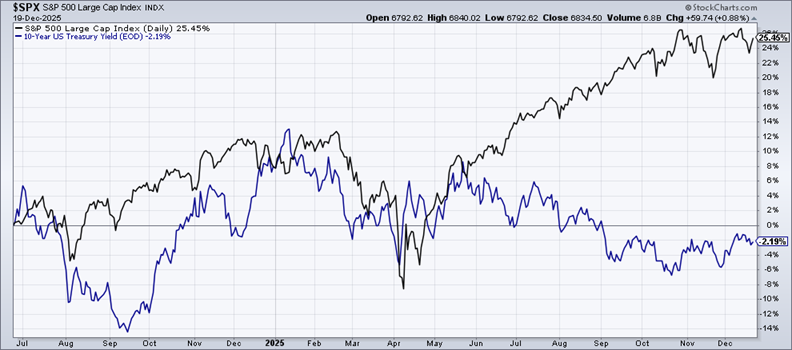
The rise of the stock market since President Trump announced higher tariffs in April has been closely correlated with a slide in the 10-year yield.

Although no one can see into the future, it’s reasonable to assume that the direction of Treasury yields in 2026 will cast a long shadow over stocks.

For the moment, markets seem comfortable with assuming that yields will hold in a range. The key task in the new year is watching the incoming data and deciding if it’s time to change the calculus on bonds. Hanging in the balance is the outlook for stocks. Yields don’t have to continue falling to keep equities bubbling, but my guesstimate is that the mood in the bond market will be a crucial factor for how equities fare in 2026.  


Macro Briefing: 22 December 2025

The Capital Spectator -

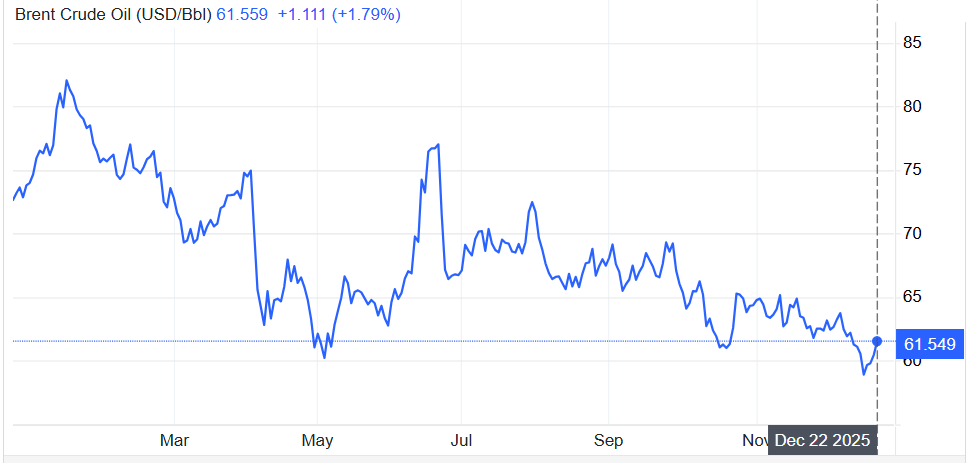
US is pursuing third oil tanker linked to Venezuela, highlighting escalating tensions between the two countries. The “active pursuit” pursuit of the tanker by the US Coast Guard is related to a “sanctioned dark fleet vessel that is part of Venezuela’s illegal sanctions evasion”, a US official said. “It is flying a false flag and under a judicial seizure order.” The news is a factor that’s lifting oil prices today. “The market is waking up to the fact that the Trump administration is taking a hardline approach to Venezuelan oil trade,” said June Goh, senior oil market analyst at Sparta Commodities.

China kept a key interest rate benchmark unchanged for seventh straight month. China’s central bank kept policy steady despite recent economic weakness and an ongoing slump in its property sector.

The price of copper, a key commodity for the energy transition, rallies to a new high. Several Wall Street banks predict the metal will continue to rise in 2026.

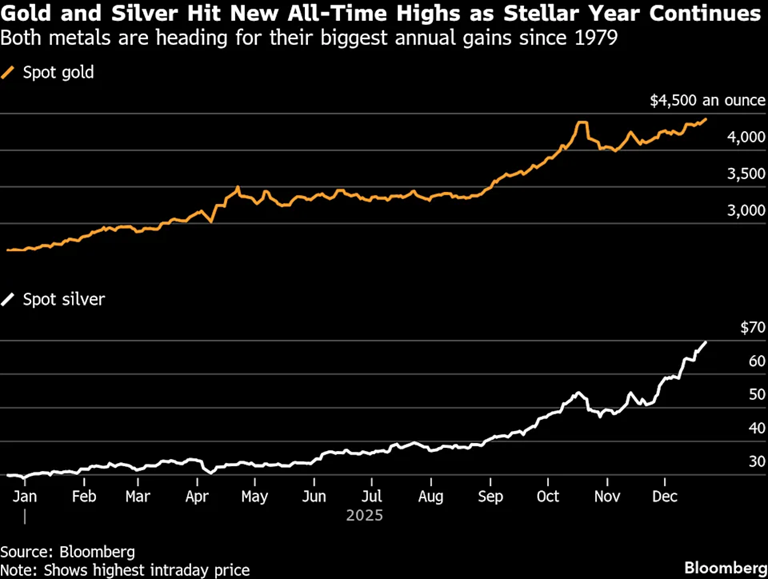
Gold and silver prices rise to new record highs. Analysts cite escalating geopolitical tensions and expectations that the US Federal Reserve will continue to cut interest rates as factors.

Pages