Feed aggregator

Small Cap Stocks Continue To Roar In 2026

The Capital Spectator -

Three weeks ago I wondered if the leadership rotation this year toward small- and micro-cap stocks would persist. There have been multiple false dawns in recent years as large caps and growth stocks regained the performance crown after a burst of small-cap strength. The case for arguing this time is different is still shaky, but small-cap strength persists, based on a set of equity risk factor ETFs through yesterday’s close (Feb. 3).

Leading the charge higher this year: micro caps (IWC), which is still running hot in 2026 and posting an 8.7% year-to-date gain. In close pursuit: small-cap value (IJR) and small-cap core (IJR). Large-cap value (IVE) and large-cap (IVW), by contrast, are trailing by wide margins, as is the equity market benchmark via SPDR S&P 500 ETF (SPY). To top off the point, note that large-cap growth is slightly in the red so far this year via an 0.8% loss.

We’ve been here before and so a healthy dose of skepticism is still in order before assuming that this year’s leadership shift is the new world order for the stock market will prevail in the months (and years?) ahead. As reported on these pages many times in recent years, early signs of a small-cap resurgence have come to naught. In Oct. 2024, for example, some analysts predicted that a turning point in favor of small caps had arrived, which prompted our question: Are Reports Of Small-Cap Stocks’ Revival Prospects Premature?

The answer was forthcoming: small caps continued to struggl, again, to keep pace, much less outperform, large caps.

As this year kicks in, the question of staying power is again topical, and once again there are analysts giving encouraging odds that the small-cap rally will persist and thrive. A familiar refrain: valuations for smaller companies look enticing when compared to lofty heights for large caps, led by the tech darlings.

“According to our valuations, we think they have further to run,” reasoned Morningstar Chief US Market Strategist Dave Sekera last week.

Looking forward, our economics team forecasts at least two more cuts to the fed-funds rate this year and long-term interest rates to fall further. Plus, the AI buildout boom has spurred faster-than-expected economic growth. Historically, small-cap stocks perform best when the Fed is easing monetary policy, long-term interest rates are declining, and the rate of economic growth is reaccelerating.

Eric Diton, president and managing director of The Wealth Alliance, is also on the bandwagon and forecasts earnings momentum will keep the small-cap train running. “Small stocks have been crushed by large stocks’ outperformance in the last 15 years,” he notes in an interview with Reuters a few days ago. But the tide is turning, he says. The engine for the shift: “We’re expecting some big small-cap earnings this year and next. We’re overdue for some big small-cap outperformance.”   

Using the iShares Small Cap Core ETF (IJR) as a benchmark suggests the tailwind of optimism continues to blow strong from the perspective of the trend bias.

If IJR can muster another leg up and take out its previous high at just over 130, the case for expecting it’s different this time will strengthen. That alone won’t ensure an extended run of outperformance, but it’s a start. Rebuilding confidence and laying the foundation for a durable run of small-cap leadership will take time, but repair and recovery efforts are off to an encouraging run in the early weeks of 2026.


Total Return Forecasts: Major Asset Classes | 3 February 2026

The Capital Spectator -

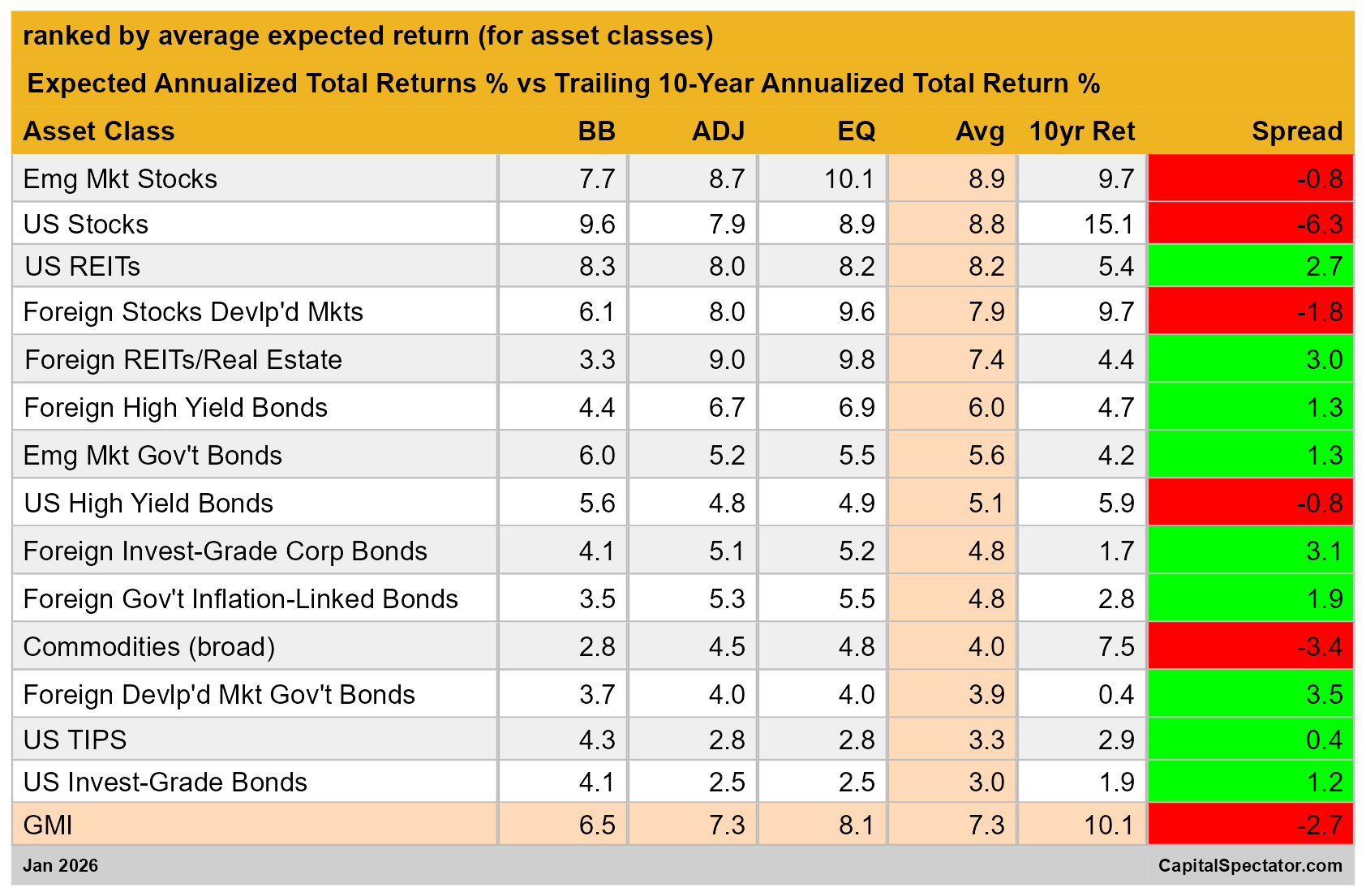
The long-term return forecast for the Global Market Index (GMI) held steady in January at 7%-plus while the benchmark’s trailing 10-year shot higher through last month, rising above 10%. The near-three-percentage-point spread between the high-flying trailing results and the relatively moderate outlook is unusually wide. The gap suggests that investors should manage expectations down for the performance outlook for globally diversified portfolios in the years ahead.

GMI is a market-value weighted mix of the major asset classes (excluding cash) via ETF proxies. Today’s forecast is calculated as the average of three models (defined below). The current 7.3% annualized estimate for GMI is unchanged from the January estimate, but remains well below the trailing 10.1% annualized return that GMI has generated over the past decade.

In the wake of strong gains in several markets and asset classes recently, nearly half of GMI’s components are projected to generate returns that are below results for the past ten years. Ditto for GMI, which is currently projected to earn a substantially softer return compared with its performance over the trailing ten-year window through January.


GMI represents a theoretical benchmark for the “optimal” portfolio that’s suited for the average investor with an infinite time horizon. Accordingly, GMI is useful as a starting point for customizing asset allocation and portfolio design to match a particular investor’s expectations, objectives, risk tolerance, etc. GMI’s history suggests that this passive benchmark’s performance will be competitive with most active asset-allocation strategies, especially after adjusting for risk, trading costs and taxes.

It’s likely that some, most or possibly all of the forecasts above will be wide of the mark in some degree. GMI’s projections, however, are expected to be somewhat more reliable vs. the estimates for its  components. Predictions for the specific markets (US stocks, commodities, etc.) are subject to greater volatility and tracking error compared with aggregating the forecasts into the GMI estimate, a process that may reduce some of the errors through time.

Another way to view the projections above is to use the estimates as a baseline for refining expectations. For instance, the point forecasts above can be adjusted with additional modeling that accounts for other factors and models not used here. Customizing portfolios for a specfic investor, to reflect risk tolerance, time horizon, and so on, is also recommended.

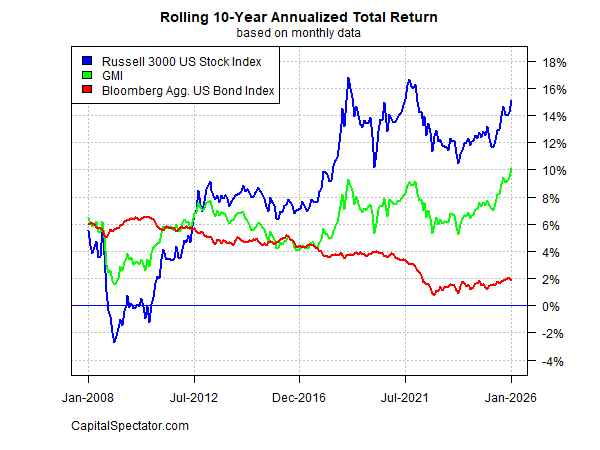
For perspective on how GMI’s realized total return has evolved through time, consider the benchmark’s track record on a rolling 10-year annualized basis. The chart below compares GMI’s performance vs. ETFs tracking US stocks and US bonds through last month. GMI’s current return for the past ten years is a sizzling 10.1%, a roaring performance that marks the strongest pace by far for the historical record shown.

Here’s a brief summary of how the forecasts are generated and definitions of the other metrics in the table above:

BB: The Building Block model uses historical returns as a proxy for estimating the future. The sample period used starts in January 1998 (the earliest available date for all the asset classes listed above). The procedure is to calculate the risk premium for each asset class, compute the annualized return and then add an expected risk-free rate to generate a total return forecast. For the expected risk-free rate, we’re using the latest yield on the 10-year Treasury Inflation Protected Security (TIPS). This yield is considered a market estimate of a risk-free, real (inflation-adjusted) return for a “safe” asset — this “risk-free” rate is also used for all the models outlined below. Note that the BB model used here is (loosely) based on a methodology originally outlined by Ibbotson Associates (a division of Morningstar).

EQ: The Equilibrium model reverse engineers expected return by way of risk. Rather than trying to predict return directly, this model relies on the somewhat more reliable framework of using risk metrics to estimate future performance. The process is relatively robust in the sense that forecasting risk is slightly easier than projecting return. The three inputs:

* An estimate of the overall portfolio’s expected market price of risk, defined as the Sharpe ratio, which is the ratio of risk premia to volatility (standard deviation). Note: the “portfolio” here and throughout is defined as GMI

* The expected volatility (standard deviation) of each asset (GMI’s market components)

* The expected correlation for each asset relative to the portfolio (GMI)

This model for estimating equilibrium returns was initially outlined in a 1974 paper by Professor Bill Sharpe. For a summary, see Gary Brinson’s explanation in Chapter 3 of The Portable MBA in Investment. I also review the model in my book Dynamic Asset Allocation. Note that this methodology initially estimates a risk premium and then adds an expected risk-free rate to arrive at total return forecasts. The expected risk-free rate is outlined in BB above.

ADJ: This methodology is identical to the Equilibrium model (EQ) outlined above with one exception: the forecasts are adjusted based on short-term momentum and longer-term mean reversion factors. Momentum is defined as the current price relative to the trailing 12-month moving average. The mean reversion factor is estimated as the current price relative to the trailing 60-month (5-year) moving average. The equilibrium forecasts are adjusted based on current prices relative to the 12-month and 60-month moving averages. If current prices are above (below) the moving averages, the unadjusted risk premia estimates are decreased (increased). The formula for adjustment is simply taking the inverse of the average of the current price to the two moving averages. For example: if an asset class’s current price is 10% above its 12-month moving average and 20% over its 60-month moving average, the unadjusted forecast is reduced by 15% (the average of 10% and 20%). The logic here is that when prices are relatively high vs. recent history, the equilibrium forecasts are reduced. On the flip side, when prices are relatively low vs. recent history, the equilibrium forecasts are increased.

Avg: This column is a simple average of the three forecasts for each row (asset class)

10yr Ret: For perspective on actual returns, this column shows the trailing 10-year annualized total return for the asset classes through the current target month.

Spread: Average-model forecast less trailing 10-year return.


How to Keep Paying the Bills When You’re Sick or Injured

Money Under 30 -

Who can blame you if money isn’t the first thing on your mind when you get sick or become injured? You’re probably just thinking about how long it will be before you start to feel better. However, eventually, you’ll have to turn your attention to the financials, especially once the bills start to pile up. […]

Major Asset Classes | January 2026 | Performance Review

The Capital Spectator -

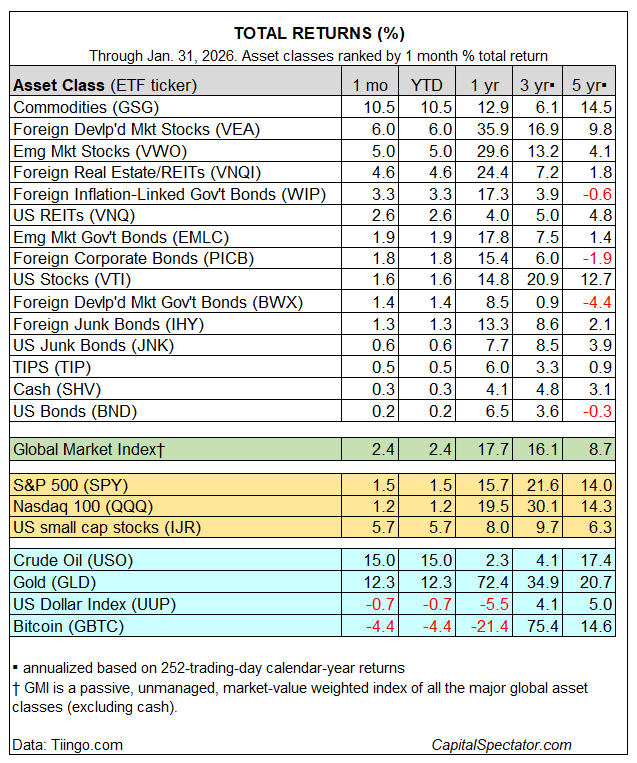
Commodities and foreign stocks led the performance race in January for the major asset classes, based on a set of ETF proxies. Meanwhile, offshore assets, supported by a weak dollar, outperformed their US counterparts by a wide margin.

A broad measure of commodities led the way higher in January. The iShares S&P GSCI Commodity Indexed Trust (GSG) soared 10.5% last month, marking the fund’s strongest monthly performance in 2-1/2 years.

Foreign stocks were in second and third place in January’s horse race. Developed-market shares ex-US (VEA) rose 6.0%, with stocks in emerging markets (VWO) in close competition via a 5.0% increase.

US stocks (VTI) trailed by a wide margin, rising 1.6% in January. US bonds (BND) only managed to post a thin 0.2% advance. US small-cap stocks, by contrast, delivered strong results, blowing past other slices of US markets with a sizzling 5.7% rise, based on iShares Core S&P Small-Cap ETF (IJR).

Despite a wide array of performances in 2026’s kickoff, January was notable for across-the-board gains for the major asset classes. In 2025, there were three months of rallies in all corners.

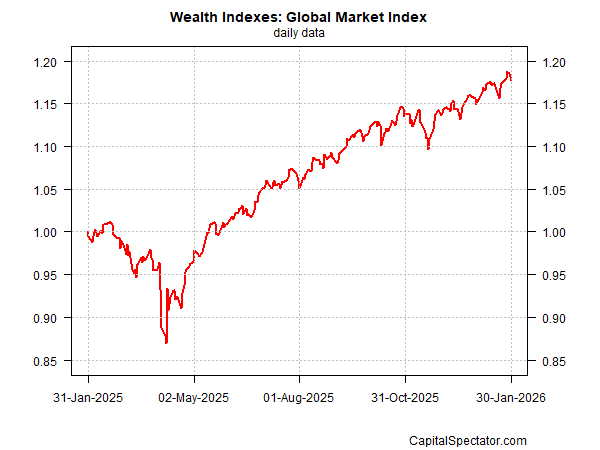
The Global Market Index (GMI) kicked off the year with a strong start, jumping 2.4% — its best monthly gain since September. With the latest rise, GMI extended its string of monthly gains to ten in a row, the longest run of wins in eight years. GMI is an unmanaged benchmark (maintained by CapitalSpectator.com) that holds all the major asset classes (except cash) in market-value weights via ETFs and represents a competitive benchmark for multi-asset-class portfolios.


Book Bits: 31 January 2026

The Capital Spectator -

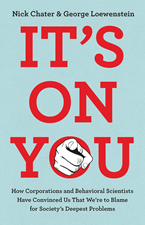
It’s on You: How Corporations and Behavioral Scientists Have Convinced Us That We’re to Blame for Society’s Deepest Problems
Nick Chater and George Loewenstein
Summary via publisher (Basic Venture)
Two decades ago, behavioral economics burst from academia to the halls of power, on both sides of the Atlantic, with the promise that correcting individual biases could help transform society. The hope was that governments could deploy a new approach to addressing society’s deepest challenges, from inadequate retirement planning to climate change—gently, but cleverly, nudging people to make choices for their own good and the good of the planet. It was all very convenient, and false. As behavioral scientists Nick Chater and George Loewenstein show in It’s on You, nudges rarely work, and divert us from policies that do. For example, being nudged to switch to green energy doesn’t cut carbon, and it distracts from the real challenge of building a low-carbon economy.

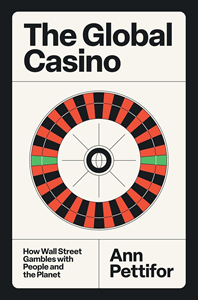
The Global Casino: How Wall Street Gambles with People and the Planet
Ann Pettifor
Summary via publisher (Verso Books)
The global market in money – housed in the offshore ‘shadow’ banking system – holds $217 trillion in financial assets and operates beyond the reach of any nation’s taxman. Asset managers, private equity firms, and pension and sovereign wealth funds scoop up the world’s savings for investment and manage them as they choose, unaccountable to politicians or the citizens who elect them. Ann Pettifor links the activities of remote mobile financial markets to both the cost-of-living and climate crises. In an insane global casino, bankers are gambling with our future. When we foot the bill, no one but a few economists understands what has happened. The result is volatile, unpre­dictable and uncontrollable speculation in global commodities, pension, energy, and housing.

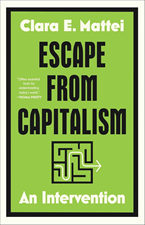
Escape from Capitalism: An Intervention
Clara E. Mattei
Review via Jacobin
In Escape from Capitalism: An Intervention, Clara Mattei dispels the anti-worker ideology that permeated mainstream economists’ analysis of Joe Biden–era inflation. Rather than treating macroeconomic challenges as technical problems with technical fixes, Mattei shows that economics under capitalism is fundamentally political in nature. While central bank technocrats present raising interest rates as a technical solution to inflation, the real effect is to raise unemployment and increase employers’ bargaining power over workers. The power of unelected technocrats to strengthen capitalist power reveals the class character and antidemocratic foundations of the capitalist economy.

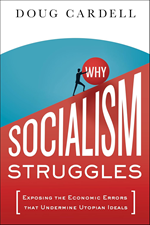
Why Socialism Struggles: Exposing the Economic Errors That Undermine Utopian Ideals
Doug Cardell
Summary via publisher (Greenleaf Book Group)
There are few issues more topical these days than government and the economy. Many political and public figures throw around terms like socialism, fascism, and capitalism without knowing what they mean or defining them for their audience. But understanding these systems and their issues is critical in helping Americans decide what ideas and proposals for action they should and should not support. In Why Socialism Struggles, economic policy expert Doug Cardell tackles this hotly debated topic with clarity, logic, and evidence. Doug explains why socialism consistently leads to inefficiency and the erosion of individual freedoms. Each answer builds toward a powerful argument: Despite its appeal in theory, socialism fails in practice because it misunderstands human behavior, incentives, and the role of prices in coordinating economic activity.

Polar War: Submarines, Spies, and the Struggle for Power in a Melting Arctic
Kenneth Rosen
Review via The Economist
Every author dreams of their book capturing the zeitgeist. Kenneth Rosen, a journalist and war correspondent, could not enjoy better timing. “Polar War” comes out just as Mr Trump has propelled the northern region to global attention. The book is a collection of reportage from different sites across the Arctic—from Alaska to the Norwegian island of Svalbard and from Swedish Lapland to Greenland itself. It is knitted together into a story of great powers competing over a region whose harsh geography imposes limits even on the abilities of superpowers.

Please note that the links to books above are affiliate links with Amazon.com and James Picerno (a.k.a. The Capital Spectator) earns money if you buy one of the titles listed. Also note that you will not pay extra for a book even though it generates revenue for The Capital Spectator. By purchasing books through this site, you provide support for The Capital Spectator’s free content. Thank you!

Foreign Bonds Lead US Fixed Income In 2026

The Capital Spectator -

Diversifying into foreign bond markets has been a winning trade for US investors during the opening month of 2026. Using a set of ETFs to track performance highlights widespread outperformance so far this year over US bonds, based on returns through yesterday’s close (Jan. 29).

Leading the field by a wide margin: inflation-indexed government bonds outside the US. The SPDR FTSE International Government Inflation-Protected Bond ETF (WIP) is up a strong 4.5% this year, well ahead of other slices of foreign fixed income as well as its US equivalent (TIP).

Notably, all the foreign bond ETFs in the chart below are outperforming the US investment-grade fixed-income benchmark: Vanguard Total Bond Market (BND), which is posting a fractional a 0.3% gain.

A weak US dollar has been a strong tailwind for foreign assets lately, including bonds. Consider that WIP’s 4.5% year-to-date rally has been accompanied by 1.6% loss in an ETF proxy (UUP) for the greenback so far in 2026.

Inflation is another concern that’s supporting WIP, a risk factor that’s come into sharper focus lately as debt levels in several of the major economies around the world are at or near record levels. As a result, governments are paying out higher levels of interest, which further lifts debt loads and threatens to raise inflation.

The International Monetary Fund estimates that in six of the seven G7 nations – a group of the wealthiest countries, including the US – government debt matches or exceeds economic output.

Amid worries about the fiscal path ahead, investors are increasingly seeking refuge in inflation-hedged securities for bond-market allocations. The sentiment shift is also a factor driving gold prices higher – the SPDR Gold Shares ETF (GLD) has soared 25% so far in 2026, reflecting a growing appetite to own an asset that’s immune to fiscal risk and the fragilities linked to fiat currencies.

“The World Economy Is Hooked on Government Debt,” reports The Wall Street Journal this week. “It’s a red flag. It’s another symptom of the vulnerabilities bubbling under the surface of advanced economies,” said Neil Shearing, chief economist at Capital Economics in London.

Is Recession Risk Rising? Monitor the outlook with a subscription to:
The US Business Cycle Risk Report

The Fed’s Job Isn’t Getting Any Easier

The Capital Spectator -

The Federal Reserve left interest rates unchanged yesterday, as expected, but the challenges are increasing for identifying the right monetary policy for the path ahead.

It’s tempting to think otherwise after reading the Fed statement issued on Wednesday: “Available indicators suggest that economic activity has been expanding at a solid pace. Job gains have remained low, and the unemployment rate has shown some signs of stabilization. Inflation remains somewhat elevated.”

Hardly ideal, but good enough to leave the Fed’s target rate steady at a 3.5%-to-3.75% and argue that the central bank’s policy matches an economy that’s stabilized and growing. But the risks of a policy mistake may be growing. The bad news is that it’s not obvious what type of mistake is lurking as it continues to juggle the threat of inflation against a softer labor market.

For now, the Fed still seems to be betting that the recently stalled moderation of inflation will resume a downward path in the months ahead, paving the way for more rate cuts. Running the latest Fed statement through an AI program (with access to the historical economic data and analysis) suggests a bias for more cuts in the year ahead, per the chart below.


The Fed funds futures market is more cautious on the outlook, but sentiment is pricing in a resumption of rate cuts starting in June.

The policy-sensitive US 2-year yield is cautiously on board with a dovish policy path… maybe. This yield, which is widely followed as a proxy for policy expectations, ticked lower again yesterday, dipping to 3.58%, or close to the lower range of the Fed’s target rate.

The core of the case for favoring more rate cuts is, as the Fed statement termed it, “low” job gains of late. The tricky part is that while hiring has slowed, layoffs have remained low and “the unemployment rate has shown some signs of stabilization,” the FOMC statement notes. In other words, current conditions leave room for debate about whether a “normal” business-cycle process is playing out that requires rate cuts to offset a downshifting labor market.

The jury’s still out on how to interpret the slowdown in hiring. One line of reasoning is that the labor supply has fallen to the point that the breakeven level for job creation – the number of monthly payrolls jobs required to maintain a stable unemployment rate – has declined. By some accounts, the breakeven jobs level has fallen from 100,000-150,000 new hires a month in the recent past to 30,000 to 60,000 in late-2025.

On that basis, the labor market can slow without raising recession risk, or so the theory goes. A degree of support for this assumption can be found in the relatively stable and low unemployment rate – 4.4% as of December – and a low level of jobless claims, which totaled 200,000 for the week through Jan. 17, which is near the lowest level in four years.

If a softer labor market isn’t a threat to the economy that it appears to be, that opens the door to leave interest rates steady. In turn, inflation can be the main focus for the Fed, but here, too, the outlook is cloudy as economists continue to struggle to explain recent history and use that analysis to project the near-term outlook.

The Fed’s preferred measure of inflation – the PCE price index – suggests that pricing pressure has turned sticky in the upper 2% range, which is moderately above the Fed’s 2% target. The dilemma is that more rate cuts could keep inflation moderately elevated, if not provide more fuel to move the pricing trend higher later in the year.

The 10-year Treasury yield appears to be picking up on the potential for inflation risk. The benchmark rate, after bottoming in October at roughly 3.95%, has been gradually trending up, closing yesterday at 4.25%. A similar rise has been unfolding with the 30-year yield, the most inflation-sensitive maturity.

Part of the reason why long rates have been edging up isn’t inflation per se. The outlook for economic activity has improved and recession fears have receded. The Atlanta Fed’s GDPNow model is nowcasting that the upcoming (and delayed) fourth-quarter GDP report will show an ongoing acceleration in output. Other nowcasts for Q4 indicate a softer pace of growth, but the common denominator is that the odds that a recession has started, or is imminent, are low if not nil. An early read on the Dallas Fed’s Weekly Economic Index (WEI) also points to comparable growth compared with recent history. An early estimate of economic conditions for January (as of Jan. 17) also point to an ongoing expansion, based the Dallas Fed’s Weekly Economic Index.

The Fed’s challenge is deciding if inflation or a slower labor market is the bigger risk. That’s always a judgment call, but it’s especially challenging these days, and it comes with a particular set of issues since the central bank can’t effectively combat both risks at the same time.

A critical component in the mix is how the bond market interprets the Fed’s policy decisions going forward. Using the 10-year yield as a guide, the crowd appears to be increasingly skeptical that rate cuts are warranted. The benchmark rate’s recent rise could be noise, but if it continues to trend up the macro calculus could change, perhaps dramatically.

A key level to watch: 4.30%. If the 10-year yield breaks above this level, and keeps on running, the Fed may be forced to revise its policy plans.


Is Weak Consumer Sentiment Flashing A Economic Warning?

The Capital Spectator -

Confidence in the economy fell sharply in January, slumping to a 12-year low, according to the Conference Board latest survey data. On its face, the sharp drop raises questions about consumer spending in the months ahead. But until there’s confirmation in the hard data, it’s best to view the polling cautiously and look for supporting context in other numbers.

The surprise drop in the Consumer Confidence Index (CCI) for this month could be an early warning for the economy, which is powered by consumer spending. But history suggests reserving judgment is sensible when you consider that the relationship between survey data and the economy is weak.

It could be different this time, of course, but it’s too early to confidently make that call. Nonetheless, the latest results are worrisome. “Confidence collapsed in January, as consumer concerns about both the present situation and expectations for the future deepened,” said Dana Peterson, chief economist at The Conference Board. “All five components of the Index deteriorated, driving the overall Index to its lowest level since May 2014 (82.2) — surpassing its COVID-19 pandemic depths.”

To gauge if CCI is noise or signal for near term it’s essential to look for confirmation in other data sets, and on that point the numbers from elsewhere still leave plenty of room for debate. Let’s start with an alternative measure of the mood on Main Street via Consumer Sentiment Index: the University of Michigan’s polling also shows subdued sentiment in January, hovering near the lowest level since 2022. But the Consumer Sentiment Index turned up this month. Here, too, there are concerning signs, but the latest reading suggests that not much changed this month vs. recent history.

Turning to hard data on spending paints a brighter picture, albeit one based on lagging numbers due to the government shutdown. Looking through the short-term noise, the year-over-year change in personal consumption expenditures rose 5.4% through November, a middling pace relative to previous months in 2025.

A more timely update of consumer spending habits also shows that the recent bias for growth continues. The Redbook Index tracks same-store sales and the 7.1% year-over-year increase through Jan. 24 is in line with results over the past several months.

Turning to the broader economic trend, the Dallas Fed’s Weekly Economic Index (WEI) also points to comparable growth compared with recent history. Reporting on data through Jan. 17, WEI continues to print at 2%-plus reading, which is in line with the relatively solid 2.3% four-quarter GDP growth through third quarter 2025.

As for the upcoming (and delayed) fourth-quarter GDP report, the current debate is whether growth accelerated (per the Atlanta Fed’s GDPNow model), or slowed to a moderate but still-encouraging pace, as indicated by the median of several nowcasts, as The Capital Spectator reported on Friday.

Given the preponderance of relatively upbeat data beyond polling consumers, the hard numbers suggest we should be wary of reading too much in mood measures on Main Street for managing economic expectations.

“Admittedly, the expectations index has greatly overstated the weakness in spending in recent quarters,” said Oliver Allen, senior U.S. economist at Pantheon Macroeconomics. “But we’d ‌be surprised if its recent deterioration proves to be an entirely false signal, particularly given the recent stagnation in real incomes and the already rock-bottom personal saving ​rate.”

Fair enough. But until the implied warnings in consumer surveys start resonating in other data sets, it’s still best to take a trust-but-verify approach to polling-based warnings.

Is Recession Risk Rising? Monitor the outlook with a subscription to:
The US Business Cycle Risk Report

What Are the Pros and Cons of DX Coils?

Money Under 30 -

Direct expansion coils (usually shortened to DX coils) are everywhere in HVAC and process cooling, yet they’re often treated as a default choice rather than a deliberate one. They show up in rooftop units, split systems, air handlers, and countless packaged solutions. Because they’re so common, it’s easy to assume they’re always the right answer. […]

Fed Rate Cuts On Hold Till June, According To Market Forecasts

The Capital Spectator -

The Federal Reserve is expected to leave its target rate unchanged at tomorrow’s policy meeting, marking a shift after three straight cuts in 2025. Keeping rates steady is the current outlook until June, but several factors are in play that could change the calculus in the weeks ahead.

Let’s start with what appears likely: the Fed funds futures market is pricing in a high probability that the central bank will keep its target rate steady at a 3.5%-to-3.75% range at tomorrow’s FOMC meeting.

The policy-sensitive 2-year Treasury yield is aligned with the no-change outlook. The difference between this widely-followed yield and the current effective Fed funds (EFF) rate is close to the smallest spread in nearly a year. That’s a sign that this slice of the Treasury market is no longer anticipating rate cuts, which was the case in previous months, when the 2-year yield traded well below EFF – falling below -80 basis points at one point last May.

As always, the outlook turns increasingly cloudy the further beyond the next FOMC meeting we look, but a host of conflicting factors make looking ahead unusually challenging.

One source for thinking that the Fed will be hard pressed to cut rates anytime soon: US economic activity has remained resilient, which suggests that easing policy further is unnecessary if not inflationary.

Although some economists last year warned that recession risk was rising, recent nowcasts for the upcoming (and delayed) fourth-quarter GDP report are pointing to ongoing strength. The Atlanta Fed’s GDPNow model is currently nowcasting that Q4 growth will accelerate to 5.4%, which (if correct) would mark the highest output in four years.

Analysts warn that developing relatively reliable Q4 nowcasts is still challenging because of the lingering effects from the government shutdown in October. But as The Capital Spectator reported last week, taking a more cautious view of Q4 nowcasts, by using a median estimate from several sources, still points to a relatively robust, if slower economy in the final three months of 2025. On that basis, there’s arguabbly still a case for going slow with policy changes, if not pausing rate cuts.

Peter Hooper, vice chair of research at Deutsche Bank, agrees. “It’s time to sit back and take a look at things,” he tells The New York Times. “We will get some further easing, but it’s not urgent at this point.”

The counterview is that inflation, for all the concern surrounding a tariff-driven shock, remains relatively stable, which in turn leaves room for more rate cuts, if only as insurance to keep the economy humming. Last week’s delayed update of November’s personal consumption expenditures price index – the Fed’s preferred measure of inflation – ticked up to a 2.8% year-over-year pace for headline and core readings. That’s up from 2.7% in October, and slightly further above the Fed’s 2% target.

The Richmond Fed’s analysis of the latest monthly PCE numbers in context with the historical record, however, suggest that “inflation is behaving as it did prior to the pandemic, in a manner broadly consistent with — or slightly below — the Fed’s 2 percent target.”

Meanwhile, the jury’s still out on whether the recent updates showing a slowdown in hiring is sign of a broader economic slowdown in progress. Some economists say that the marked downshift in payrolls growth warrants more rate cuts. The pushback is that softer hiring has yet to translate to a rise in layoffs, as indicated by the low level of jobless claims in recent months.

Adding to the Fed’s challenge of setting rates in a complex macro environment is the ongoing political pressure from the White House to ease policy further. President Trump last week renewed his criticism of Fed Chair Jerome Powell and told CNBC that inflation had been “defeated.”

Perhaps the Fed’s biggest challenge is persuading markets that, whatever the central bank decides in the months ahead, it’s setting rates based on independent analysis of the economy. That’s getting harder at a time of an ongoing criminal investigation of Fed Governor Lisa Cook, which some observers say is a thinly-veiled effort by the White House to influence the central bank’s decisions in favor of more rate cuts by opening up a new seat at the Fed.

Further roiling the outlook: Powell’s tenure as Fed chair ends in May, and it’s unclear how a new Fed chair would influence policy.

So far, however, the Treasury market appears relatively calm, and so it can be argued that the crowd isn’t particularly worried. The benchmark 10-year yield, although it’s increased lately to the highest level since August a few days ago, is still trading at a middling range vs. recent history.

A rise in this key yield above its recent trading range could change the calculus, perhaps dramatically. All the more so at a time of growing concern about government debt around the world.

The rise of gold above $5000 an ounce this week highlights the growing concerns related to the so-called debasement.

“We’re at the start of a global debt crisis, with markets increasingly fearful governments will attempt to inflate away out-of-control debt,” wrote Robin Brooks, a senior fellow at the Brookings Institution and former chief economist at the Institute of International Finance.

For now, at least, the Treasury market has yet to signal trouble ahead in the form of persistently rising yields. When and if that changes, the risk calculus will change. The challenge of the moment is deciding if this is the calm before the storm, or just another round of noise driven by overbaked warnings.

Is Recession Risk Rising? Monitor the outlook with a subscription to:
The US Business Cycle Risk Report

How to Conduct OSHA Compliant Work Physicals

Money Under 30 -

Work physicals are a routine part of many jobs, especially in industries where safety, physical capability, and regulatory compliance intersect. While they can sometimes feel like a box to check, OSHA-compliant work physicals serve a practical purpose: helping ensure employees can safely perform the essential functions of their roles. The challenge for employers is balancing […]

Commodities Lead Major Asset Classes So Far In 2026

The Capital Spectator -

Prices for raw materials have rocketed higher so far this year, outperforming the rest of the major asset classes by a wide margin through Friday’s close (Jan. 23), based on a set of ETFs. Foreign stocks are currently strong, but they remain distant second‑place winners.

The Wisdom Tree Commodity Index Fund (GCC) has surged 10.7% year to date. GCC maintains a relatively diversified portfolio and so it’s not overly dependent on oil and energy, in contrast with some of its competitors. As a result, GCC’s bull run of late highlights that commodities overall are posting strong gains.

In second place this year: foreign equities, led by stocks in emerging markets (VWO) via a 5.6% return. In close pursuit: shares in developed markets ex-US (VEA), which are up 5.3%.

All the major asset classes are posting gains this year, albeit delivering a wide spectrum of results. A broad measure of the US investment-grade bond market, including Treasuries, is the weakest performer in 2026, rising a thin 0.2%, based on the Vanguard Total Bond Market ETF (BND).

US stocks are a middling performer year to date, rising 1.6% via Vanguard Total US Stock Market ETF (VTI).

Within the commodities space, precious metals are especially hot. The SPDR Gold Shares (GLD) have soared 15.6% in 2026 through Friday’s close. Early trading today (Jan. 26) point to a further rally this week as the price of the metal trades well above $5,000 an ounce for the first time. Silver (SLV) is even hotter, skyrocketing more than 44% so far in 2026.

“The rise in precious metals prices is breathtaking and profoundly scary,” wrote Robin Brooks, a senior fellow at the Brookings Institution on Sunday. The rally is “part of something much bigger,” he advised. “We’re at the start of a global debt crisis, with markets increasingly fearful governments will attempt to inflate away out-of-control debt.”

CNBC, citing a Goldman Sachs report, notes: the demand base for gold has broadened and Western ETF holdings have climbed by about 500 tons since the start of 2025.

A key factor in gold’s rally: a weak US dollar. The two assets tend to move inversely with one another. The US Dollar Index fell 1.2% this year through Friday’s close, and has declined nearly 10% over the past year.

Morningstar.com warns against chasing gold after such a strong run, but some analysts still expect higher prices in the near term.

“I think [gold] could well have some further upside,” said Steve Miller, an investment strategy adviser at GSFM, an Australia-based asset manager. “But just as good is it might insulate you from turmoil in other asset classes.”


Book Bits: 24 January 2026

The Capital Spectator -

Exile Economics: What Happens if Globalisation Fails
Ben Chu
Essay by author via The Next Big Idea Club
The idea that we should reduce dependence on foreigners has been with us for thousands of years. Take the ancient Greek Cynics. Diogenes, who famously lived in a barrel in the marketplace of Corinth, believed that self-sufficiency—living with only what you truly needed—was the highest moral state… This instinct that we are safer, purer, or more virtuous alone is remarkably resilient. It appears under every ideological banner: religious and secular, left and right, nationalist and cosmopolitan, capitalist and communist. So it’s no surprise to see it re-emerge today in debates over trade, global supply chains, and “decoupling.”

A Century of Plenty: A Story of Progress for Generations to Come
Sven Smit, et al.
Summary via publisher (McKinsey Global Institute)
This book, a major research effort from the McKinsey Global Institute, explores the advances of the past century and what drove them—what we call the progress machine. It then investigates the possibility of a world of plenty by 2100 in which every person lives at, or above, the levels of prosperity only enjoyed by the top few percent today. Such a future would require the global economy to be eight times bigger than it is today. Is this realistic? Will we have enough energy, food, metals, and minerals? Can we keep innovating quickly enough? Can we deliver plenty while protecting our planet?
We ran the numbers, and the answer is yes.

On Natural Capital: The Value of the World Around Us
Partha Dasgupta
Review via Green Central Banking
The world’s economic system has taken nature for granted and now we’re paying the price. That’s the premise of Partha Dasgupta’s latest book, On Natural Capital: The Value of the World Around Us.
Dasgupta, an economist at the University of Cambridge and author of a 2021 review of biodiversity economics for the UK government, is very concerned about the gap between the demand and supply side of natural capital. The demands on nature and what nature can supply have been over-extended, he says.
“Nature is underpriced,” he tells Green Central Banking. This is “the fundamental problem the global economy now faces … we are sunk, because you can’t just keep on drawing on nature”.

Everybody Loses: The Tumultuous Rise of American Sports Gambling
Danny Funt
Excerpt via Vanity Fair
Everything about online sports betting seems like a recipe for getting people to overdo it: the mere seconds it takes to deposit money from a bank, PayPal, or Venmo account, or even a credit card in some states; the vast menu of games and props available for betting at all hours; the incessant ads; the daily emails beckoning customers with promotions whenever they take a break from gambling. To ward off negative publicity, sportsbooks trumpet their programs for responsible gaming. These initiatives suggest that people should bet responsibly but also that operators have a responsibility to look out for their customers’ wellbeing.

Please note that the links to books above are affiliate links with Amazon.com and James Picerno (a.k.a. The Capital Spectator) earns money if you buy one of the titles listed. Also note that you will not pay extra for a book even though it generates revenue for The Capital Spectator. By purchasing books through this site, you provide support for The Capital Spectator’s free content. Thank you!

Will US Q4 Growth Exceed Q3’s Strong Pace?

The Capital Spectator -

Economic activity grew at a strong pace in the second and third quarters, according to official GDP data published by the Bureau of Economic Analysis. The party continued in Q4, based on a widely followed nowcast that projects that the robust expansion in the two previous quarters will accelerate in the government’s delayed GDP report due next month.

The Atlanta Fed’s GDPNow model is estimating that the economy increased 5.4% at an annualized rate in Q4 (as of Jan. 22). If correct, the estimate will blow past the strong 4.4% rise in Q3 and mark the strongest quarterly increase in four years.

As always, there are a number of caveats to consider in the realm of nowcasting. For starters, the GDPNow estimate has yet to show up in other estimates monitored by CapitalSpectator.com. The Atlanta Fed’s nowcast is the outlier, by a wide margin. That doesn’t mean it’s wrong. But until other nowcasts move closer to the GDPNow estimate, a degree of caution is recommended in expecting Q4 growth to accelerate.

Using the median nowcast from several models highlights a considerably slower Q4 growth rate: 2.1%. That’s still a respectable gain, but it’s a long way from 5-plus%.

On firmer ground, it’s becoming clear that the odds are low, if not nil, that a US recession started in Q4. Instead, the debate about next month’s delayed release of GDP data for the October-through-December period is whether the expansion is downshifting or picking up.

The analysis is (still) unusually tricky at the moment due to lingering effects on the economic data collection from the government shutdown in October.

Samuel Tombs, chief US economist at Pantheon Macroeconomics is among the skeptics questioning the sizzling GDPNow’s Q4 estimate, which he says is “highly questionable.” The consultancy estimates Q4 growth is substantially softer, in the 1.5% range. A key reason for doubt: some of the data during the previous quarter is still missing, and some of what has been published is questionable.

Nonetheless, a broad review of economic activity across a variety of metrics strongly suggests that the US continued to grow at a pace that minimizes recession risk. Confidently estimating the pace of growth, by contrast, is still a work in progress.

Is Recession Risk Rising? Monitor the outlook with a subscription to:
The US Business Cycle Risk Report

Foreign Stocks Extend Lead Over US Shares In 2026

The Capital Spectator -

It was a vintage performance. President Trump skewered the edifice of globalization yesterday at World Economic Forum in Davos, Switzerland. Lest anyone miss the message, he claimed that “The United States is keeping the whole world afloat” and that the status quo would no longer endure.  

US Commerce Secretary Howard Lutnick put a finer point on the President’s view, telling the Davos crowd: globalization is a “failed policy” that’s inflicted a high price on the US. “And what we are here to say is that ‘America First’ is a different model—one we encourage other countries to consider.”

Globalization may be on the defensive – some might say in its death throes — but from an investing perspective it’s thriving. Global stocks are still outperforming US shares so far in 2026, extending last year’s winning run. Using a set of ETFs through yesterday’s close (Jan. 21), all the major equity regions of the world are maintaining a healthy lead over the US.

Topping the list by a wide margin so far this year: stocks in Latin America (ILF), which have surged more than 11% so far in 2026.

Global equities ex-US are ahead 4.2% year to date — that’s a solid lead over US stocks (SPY), which are still trailing the rest of the world via a thin 0.5% increase.

These are still early days for assessing the economic and investment implications of a US that’s redefining and reinventing its role on the world stage. But to the extent that markets are offering early clues on expectations, the results imply that the sentiment continues to favor international diversification. It would be ironic if, at some future point in time, analysts look back and identify Donald Trump as the catalyst that revived the fortune of global investing strategies. Presuming that will be the case is premature. But it’s somewhat more plausible at the moment, given the strong run in offshore stocks last year that’s spilling over into 2026.

A key question for the year ahead, and beyond: Is a secular shift unfolding in global markets? A pair of analysts at Breakout Capital, writing last week for the CFA Institute’s blog, advise that an attitude adjustment appears to be in progress.

We believe we are in a new regime where there will be an increased recognition that international markets are on the mend and offer strong earnings growth and policy improvement at much cheaper valuations.

The strong cyclical advantages that the US offered 15 years ago are increasingly being chipped away creating the conditions for a multi-year tailwind in favor of international markets.

That’s still a speculative view, albeit one that’s continues to resonate so far in 2026.

This much is clear: the old world order is breaking down. What replaces it is still up for grabs. Regime shift for markets and macro is always messy and full of surprises, along with ample opportunities. The average global investor suspects that the clues of what’s coming are beginning to emerge.

Learn To Use R For Portfolio Analysis
Quantitative Investment Portfolio Analytics In R:
An Introduction To R For Modeling Portfolio Risk and Return

By James Picerno

Will The Supreme Court Expand Trump’s Influence Over The Fed?

The Capital Spectator -

It comes down to the meaning of two words: “for cause.” Hanging in the balance: the President’s ability to control how the Federal Reserve conducts monetary policy.

The Federal Reserve Act states that the President can fire Fed board member “for cause.” Exactly what that means has been vague, in no small part because no President has ever removed a Fed governor. Clarifying what that means, or doesn’t, is at the core of the case before the Supreme Court. Hanging in the balance: more than a century of law and precedent, along with the degree of freedom from government (political) influence over how it sets monetary policy.

The backstory: Trump has been pushing the Fed to lower interest rates since he returned to office a year ago. As one example, in a social media post earlier this month he wrote: “Jerome ‘Too Late’ Powell should cut interest rates, MEANINGFULLY!!!”

At issue in the case that is scheduled to go before the High Court today is the President’s attempt to fire Federal Reserve Governor Lisa Cook, arguably as part of an effort to remake the Fed and install new governors that will be amenable to lowering interest rates to a degree that satisfies Trump. Whatever the motivation, in August Trump wrote on his social media account: “you are hereby removed” from the role of Fed governor, in a reference to Cook. The announcement marked the first time since the Fed was created in 1913 that a Fed governor had been fired, or in this case an attempt to remove Cook.  

US District Judge Jia Cobb in September ruled that Cook, who refused to resign, could remain at the Fed while she defended herself against allegations that she committed mortgage fraud – charges made by Federal Housing Finance Agency Director Bill Pulte, a Trump appointee. 

The Supreme Court will hear arguments related to Trump’s petition to reverse a lower court judge’s ruling that prevents ​him from firing Cook while her case moves through the legal system. to the removal continues.

A related development, although it’s not formally part of the Cook case, is the Trump administration’s launch this month of criminal investigation into Fed Chair Powell regarding testimony in Congress last year about a Fed building project. Powell responded by issuing a video statement, framing the Department of Justice investigation as decision as an attack on the central bank’s ability “to set interest rates based on evidence and economic conditions — or whether instead monetary policy will be directed by political pressure or intimidation.”

“The Court has to tell us what a firable offense looks like for members of the Federal Reserve Board,” says Lev Menand, an economics law scholar at Columbia Law School and former Treasury Department official. “But it can’t be just whatever the president says it is.”

Ultimately, “This is a case that’s about much more than Cook,” Menand continues. “It’s about whether President Trump will be able to take over the Federal Reserve Board in the coming months, and the administration has been pretty clear about that.”

Betting markets are currently pricing in low odds that Cook will be removed as Governor. Kalshi’s estimate this morning of ousting is 29% by the end of this month, falling to 6% through March. Polymarket is reporting similarly low odds of removal.

Meanwhile, the business of the Fed goes on, including monetary policy. The Fed funds futures market is currently estimating a high probability that the central bank will leave its target rate unchanged at next week’s policy meeting (Jan.28).

If correct, the news may further anger President Trump. The larger question is how or if the Supreme Court decision reshuffles monetary policy expectations and decisions, and, in turn, how or if that spills over into the pricing of Treasury yields?

Whatever the outcome of the court case, it appears that politics, law and monetary policy are melding. At risk is the Fed’s autonomy, and by extension, the integrity of the financial system, real or perceived. In short, the case before the Supreme Court is much more than a decision about whether Lisa Cook can keep her job.  

Long-Term Corporates Take Early Lead In The Bond Market In 2026

The Capital Spectator -

Maturity risk has been in favor so far this year in the bond market. A couple of weeks may be misleading, but so far in 2026 the crowd’s appetite for longer maturities is resonating in fixed income, based on a set of ETFs through Friday’s close (Jan. 16).

Topping the return ledger in 2026: long-term corporates, based on Vanguard Long-Term Corporate Bond ETF (VCLT), which is up 0.9% year to date. Long-term governments (TLT) are a close second with a 0.7% rise. Both funds are running comfortably ahead of the US investment-grade bond benchmark via Vanguard Total Bond Market (BND), currently ahead by 0.2%.

Three buckets of fixed income are posting modest losses in the kick-off to 2026, led by intermediate Treasuries (IEF) via a 0.2% decline.

Reviewing numbers through last week this early in the year as a guide to 2026 comes with obvious caveats, plus one more risk factor: the weekend’s news that President Trump is intent on a US takeover of Greenland, which threatens to roil whatever we thought we knew about the near-term risk outlook for financial markets.

Trump has threatened new tariffs for the UK, France, Germany and other European nations until a deal is reached that allows Washington to “buy” Greenland. As a result, markets are bracing for the possibility of a new phase of trade war.

US markets were closed yesterday for the Martin Luther King, Jr. Day, and so the crowd’s initial reaction to the Greenland news arrives today.

“With the US off yesterday the implications of the tariff threats over Greenland had yet to fully percolate through financial markets,” Deutsche Bank’s Jim Reid wrote in a note to clients this morning. “Markets have reacted but there’s clearly room for bigger moves if the rhetoric increases further … Yesterday [Trump] declined to rule out the use of force to take Greenland, saying ‘No comment’ when asked by NBC News in an interview. That’s driven growing fears about some kind of retaliatory trade escalation from Europe, with increasingly strong comments from several officials.”

Bond investors this week will be preoccupied with the question: Will government securities remain the go-to safe-haven asset this week amid a new round of geopolitical crisis? If so, will long-term maturities continue to lead?

Ark Invest CEO Cathie Wood recently predicted that long-term Treasuries have significant upside potential and that inflation will wane. “If we’re right, growth will be much stronger and, importantly, inflation will be much, much lower than it has been with tariffs,” she said. “And we think at some point it could drop to zero or below zero if we’re right on oil continuing to fall and rents falling.”

Reviewing the bond market through Friday’s close offers a degree of support for her view, but suddenly that’s ancient history. Assumptions about risk face a new acid test this week, and investors will be watching to learn if the script will flip… again.

Is Recession Risk Rising? Monitor the outlook with a subscription to:
The US Business Cycle Risk Report

Book Bits: 17 January 2026

The Capital Spectator -

The Making of a Permabear: The Perils of Long-term Investing in a Short-term World
Jeremy Grantham with Edward Chancellor
Review via The Wall Street Journal
Buy low, sell high, get rich. Jeremy Grantham’s Wall Street career exactly conforms to this charmed sequence, but with what troubles along the way. The reader, at least, will be glad for them. They constitute the breath and the life of “The Making of a Permabear,” a memoir written with the financial journalist Edward Chancellor.
Mr. Grantham, a co-founder and longtime investment strategist at the Boston-based money-management firm GMO, can be said to have dug the ruts and potholes on his own bumpy road. He is a nonconformist. Worse, in the context of today’s flyaway stock market, he is a principled, value-minded, dogmatic nonconformist. He has nailed his colors to the mast of investment value (don’t overpay for stocks and bonds) and to the idea that profit margins and equity valuations never stray far from their respective long-term averages. He lays down the rule that “capital moves toward profits: excess returns attract competition and bad returns drive capital away. Pretty soon you have mean reversion.” Who can disagree?

The Sovereign Debt Investor: An Essential Guide to Returns, Defaults, and Government Bond Investing
Lupin Rahman
Summary via publisher (Wiley)
In The Sovereign Debt Investor: An Essential Guide to Returns, Defaults, And Government Bonds, veteran investor and sovereign debt expert Lupin Rahman delivers expert insight into global government debt markets, highlighting the unique risks and compelling opportunities of this asset class. This book bring together expertise from the world of bond investing, policy making, academia and law to which bring to life specific issues and intricacies in sovereign debt investing.

The Bookie: Inside the High-Stakes World of Sports Betting―A Legendary Bookmaker’s Tale of Gangsters, Celebrities, and the Art of the Game
Art Manteris
Review via Kirkus Reviews
A first-generation Greek American from a Pittsburgh family of oddsmakers and gamblers, Manteris fell into the family trade almost by accident, after a string of youthful indiscretions sent his plans to be a Hollywood stuntman astray and stranded him in Vegas for what turned out to be his life. He worked his way up from changing the odds board by hand at the mob-owned Stardust Hotel on the Strip (when it was more of a strip mall in the desert than a row of luxury real estate) to innovating sports bookmaking, most notably at Caesars Palace and the Las Vegas Hilton’s SuperBook. “Most people have opinions about sports, and most think their opinions are better than the next guy’s,” he says to explain the simple appeal of sports gambling. “Having an opinion is one thing, but backing up an opinion with cash—that takes confidence and guts.”

Please note that the links to books above are affiliate links with Amazon.com and James Picerno (a.k.a. The Capital Spectator) earns money if you buy one of the titles listed. Also note that you will not pay extra for a book even though it generates revenue for The Capital Spectator. By purchasing books through this site, you provide support for The Capital Spectator’s free content. Thank you!

Are The Stars Aligning For A New Bull Run In Homebuilder Stocks?

The Capital Spectator -

The relatively weak performance of shares in the homebuilder industry for the past two calendar years is, on first glance, surprising. A long-running under-investment in home building has created a housing shortage at a time of a demographic-drive rise in demand. But holding an ETF that tracks shares in the homebuilding industry has only matched the return of the broad equity market over the past five years but at a cost of sharply higher volatility.

It’s timely to wonder if the fortunes of homebuilder stocks are poised to improve. One catalyst for change is the slide in borrowing costs. The average long-term US mortgage rate, based on the 30-year fixed rate, fell to 6.16% last week, the lowest in over three years, according to mortgage buyer Freddie Mac.

Softer borrowing costs should be a net plus at a time when, according to a recent Goldman Sachs estimate: “At least 3-4 million additional homes beyond normal construction need to be built to address the shortage in US housing supply and boost affordability.”

Despite the supply-demand tailwind, several factors have slowed the industry, including a decline in housing affordability that’s accelerated since the pandemic and various land-use restrictions, Goldman analysts note. Last week’s news that US housing starts in October fell to lowest level in nearly six years reminds that a quick fix doesn’t look imminent.

But the ongoing supply shortage, in time, will likely create conditions for a stronger run in homebuilder stocks. Politics may be a supporting factor too. The White House in recent weeks has reportedly met with industrial officials on ways to improve affordability and how the administration could help.

In a possible early hint of things to come, market sentiment has turned firmly bullish on homebuilders this year. The S&P Homebuilders ETF (XHB) has rallied more than 12% year to date through Thursday’s close(Jan. 15), far above the broad stock market’s 1.5% gain, based on the SPDR S&P 500 ETF (SPY).

Encouraging, but a couple of weeks could be noise. Meanwhile, homebuilders are still far behind equities overall for the past several years. For the trailing one-year window, for instance, SPY is handily outperforming XHB: 18.2% vs. 6.4%.

If the tide begins turning in favor of homebuilders, the investment case will look more convincing in relative terms against stocks generally. One way to monitor the trend is by tracking the ratio of XHB to SPY.

Despite the recent pop in homebuilder shares, it’s not clear that the industry’s relatively weak performance since 2024 has run its course. A stronger sign that the cycle is turning would arise when the 50-day average for this ratio recovers and rises above the 200-day average. On that basis, the jury’s still out if homebuilders are poised to outshine the broad market in 2026.

Is Recession Risk Rising? Monitor the outlook with a subscription to:
The US Business Cycle Risk Report

Materials And Energy Stocks Take Early Lead in 2026

The Capital Spectator -

The ledger of stock market’s winners and losers is highlighting a substantially different race so far in 2026, based on a review equity sectors. The year is still young and so it’s unclear if a durable change in leadership is unfolding relative to last year’s bull run. But for now, it’s obvious that sentiment has shifted in favor of shares in the materials and energy sectors, based on a set of ETFs through yesterday’s close (Jan. 14).

Currently tied for first place in 2026: materials (XLB) and energy (XLE), each fund posting a 7.5% rise. The rallies are comfortably ahead of the third- and fourth-place winners, which are also in a dead heat so far in 2026 via industrials (XLI) and consumer staples (XLP), with 5.9% gains each. The US stock market overall, via SPDR S&P 500 (SPY), is trailing with a 1.2% year to date increase.

The current leadership is striking following modest gains for materials (XLB) and energy (XLE) last year. In both cases, the 2025 performances trailed the sector leaders – tech (XLK) and communications (XLC) – by wide margins.

The one sector that’s extending a strong run in 2025 into the new year: industrials (XLI). Posting a competitive third-place finish last year, industrials continue to run hot so far in 2026.

It’s anyone’s guess if the renewed focus on commodities and related sectors will remain the dominant theme for the year ahead from a sector perspective, but the odds look encouraging so far, based on technical profiles. XLI, for instance, continues to reflect a solid bullish trend.   

It’s premature to dismiss the AI-fueled rally in tech that consumed 2025’s headlines, but after a strong run investors appear to be looking to relative laggards for opportunities that are less frothy.

“Hedge funds rotated billions from tech stocks into defensive sectors during Q4 2025,” the web site 24/7 Wall Street recently reported. “The trend continued into January 2026.”

Pages